



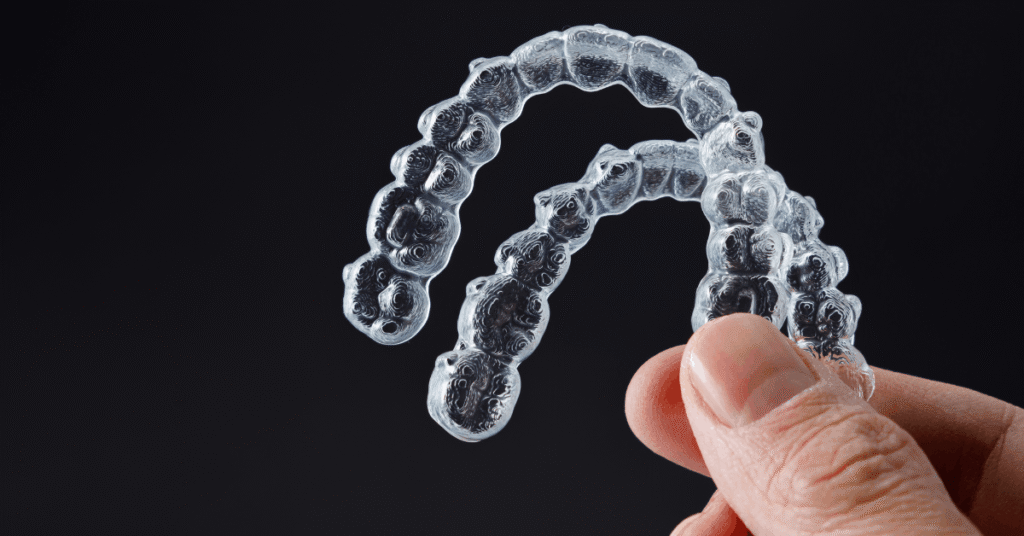
Clear aligners have a reputation for being easy. Slip them in, wear them, take them out to eat, repeat. And in some ways that’s true — they’re a lot less intrusive than traditional braces.
But they do require some real discipline, and there are a handful of mistakes that patients make regularly that slow down treatment, lead to stained or warped trays, or quietly increase the risk of cavities during the months they’re wearing them.
At Jenkins Cosmetic and Family Dentistry in Floyds Knobs, we use SureSmile® clear aligner technology — a system that builds precise 3D treatment planning into the process from the start. Part of what we do when a patient starts aligner treatment is walk through the practical side: what to do, what not to do, and what to watch for. This post covers all of that.
Why People Choose Clear Aligners in the First Place
Most patients who come to us for clear aligners have had the thought somewhere in the back of their mind for a while. They’ve considered traditional braces and decided against them — usually for appearance reasons, but also because of the dietary restrictions and the cleaning challenges that come with brackets and wires.
Clear aligners address most of those objections. The trays are nearly invisible, which matters for adults in professional settings and teenagers who don’t want a mouthful of metal during high school. They’re removable, so you eat whatever you normally eat. They don’t create sore spots on the inside of your cheeks from metal edges.
The SureSmile® system we use takes this a step further with detailed 3D imaging that maps out each stage of movement before treatment begins. Dr. Jenkins can see the planned progression tooth by tooth, make adjustments to the sequence before a single tray is made, and give patients a much more accurate sense of what the final result will look like and how long the process will take.
For many adults and teenagers in Floyds Knobs, that combination of discretion and precision is exactly what they’ve been looking for.
Cleaning Your Aligners: What Works and What Doesn’t
Let’s start with the daily maintenance routine, because this is where a lot of people develop habits that cause problems over time.
Every time you remove your aligners, rinse them under cool water. This sounds basic, but skipping it allows saliva to dry on the surface, leaving a film that becomes increasingly difficult to remove and causes the trays to look cloudy rather than clear.
For a proper clean — at least twice a day — use a soft-bristled toothbrush with either clear, unscented liquid soap or a specialized aligner cleaning solution. Brush gently across all surfaces, inside and out. Rinse thoroughly.
Two things to avoid: toothpaste and hot water.
Toothpaste seems like a logical choice, but most formulas contain abrasive particles designed to polish tooth enamel. Those same particles will scratch your aligners, creating a rougher surface that attracts bacteria more easily and makes the trays look permanently foggy. Use soap instead.
Hot water is another common mistake. Aligner trays are made from a thermoplastic material calibrated precisely to fit your teeth. Heat — even from a warm tap, let alone boiling water — can distort the shape. A warped aligner doesn’t apply the right pressure to the right teeth, which throws off the movement plan. Always cool or lukewarm water.
For anyone who wants to go a step further, aligner cleaning crystals or retainer tablets dissolved in cool water are a good weekly deep-clean option. They remove biofilm that brushing can miss.
And the case — use it every single time your aligners are out of your mouth. Aligners left on a napkin at a restaurant get thrown away more often than you’d think. Aligners left on a bathroom counter can be knocked off, sat on, or contaminated. The case is there for a reason.
Eating, Drinking, and the Rules That Matter
The main rule is simple: remove your aligners before eating or drinking anything other than plain, cool water. But it’s worth understanding why, because knowing the reason makes it easier to stick to.
Chewing with aligners in place can crack them. The trays are engineered to apply gentle, controlled pressure to specific teeth — not to absorb the compressive force of chewing. Even soft foods can create stress at the edges or thin points of the tray.
Coloured drinks stain them. Coffee, tea, soft drinks, juice, red wine — any of these can discolour your trays over time, especially if you’re drinking them regularly with the aligners in. The whole appeal of clear aligners is that they’re barely visible. Staining defeats that.
Food and drink trapped against your teeth under a sealed tray creates an elevated risk of cavities. Sugars and acids from food and drink sitting against tooth enamel under an aligner is exactly the environment that decay-causing bacteria love. This is one reason that aligner patients who don’t maintain excellent hygiene can end up with more cavities than they had before treatment started.
When you remove your aligners to eat, brush your teeth before putting them back in. If you’re somewhere you can’t brush — at a restaurant, at work — rinse your mouth thoroughly with water first. The goal is to clean teeth before the tray seals against them.
Wear Time: This Is the Part That Determines Your Outcome
Clear aligners work by applying gentle, consistent pressure to move teeth incrementally. That pressure only exists when the aligner is in your mouth.
For treatment to progress as planned, aligners need to be worn 20 to 22 hours every day. The remaining two to four hours cover eating, drinking, brushing, and cleaning the aligners.
Patients sometimes push this — leaving aligners out for an extra hour here, an extra two hours there. It’s easy to rationalise at the moment. But teeth that aren’t under the planned pressure start to drift back, even slightly. Over several weeks, those small drifts add up. The next tray in the sequence might not fit correctly. Treatment takes longer. In some cases, refinement trays are needed to get back on track.
The patients who finish treatment on time with the results they expected are almost always the patients who were strict about wear time. It’s the single biggest variable in how aligner treatment goes, and it’s entirely in the patient’s control.
If wearing them consistently is a challenge in the early weeks, a few things help: setting a reminder when you take them out to eat, keeping the case somewhere visible, and building the habit of putting them back in immediately after brushing — not after finishing the cup of tea, not after the next show, immediately.
Professional Cleanings During Treatment
Routine dental cleanings are important all the time. During aligner treatment, they become more important.
Here’s the issue: aligners sit snugly over your teeth, which creates an environment where food particles and bacteria can accumulate at the margins — the edges where the tray meets the gum line. Even patients with genuinely good brushing habits can miss plaque in these areas during treatment.
Plaque that isn’t removed hardens into tartar, which can only be removed with professional instruments. Left unaddressed, tartar build-up contributes to gum inflammation. And moving teeth through inflamed gum tissue is clinically complicated — it can slow treatment and affect the quality of results.
At our practice, we monitor aligner patients between tray sets, check that teeth are tracking as planned, and keep an eye on gum health throughout treatment. We may suggest coming in for a cleaning more frequently than every six months, depending on how your hygiene is holding up during treatment.
If you notice your gums bleeding more than usual, or feeling tender around the aligner margins, mention it at your next check-in. It’s usually a straightforward fix when caught early.
When a Tray Is Lost or Damaged
It happens. Call us as soon as you can rather than waiting for your next scheduled appointment.
The right response depends on how long you’ve been in that particular tray set. If you’re six or seven days into a two-week set and your teeth have already moved most of the way, we may advise you to move ahead to the next tray early. If you’re only a couple of days in, we’ll more likely suggest going back to the previous set temporarily while a replacement is sorted out.
Either way, act quickly. Every day without an aligner is a day your teeth aren’t being guided, and they can start to drift in that time. The longer you wait to tell us, the more complicated the recovery.
To reduce the chances of this happening: always use the case, don’t wrap trays in napkins, and before removing them in an unfamiliar place, take a second to think about where you’re going to put them.
After Treatment: Retainers
When your final aligner set is done, the work isn’t quite over. Teeth have a natural tendency to drift toward their pre-treatment positions, particularly in the months immediately after orthodontic treatment ends. Retainers are what prevent that.
We’ll fabricate a custom retainer from a scan taken at the end of your treatment. Initially it’s worn full-time, then transitions to nights only after a period of stability. For most patients, some form of nighttime retainer wear continues indefinitely — not a burden once it’s routine, and the most effective way to protect the result you worked for.
Retainer care is similar to aligner care: cool water, gentle brushing, no toothpaste, always in the case when not in use.
Getting Started
Jenkins Cosmetic and Family Dentistry is at 750 Highlander Point Dr, Floyds Knobs, IN 47119, and serves patients throughout Floyds Knobs, New Albany, Greenville, and the surrounding communities. Office hours are Monday–Wednesday 8:30 AM–4:30 PM, Thursday 8:30 AM–3:30 PM, and Friday 8:00 AM–2:00 PM.
Call (812) 923-2200 or book at jenkinsfamilydentistry.com to schedule a clear aligner consultation. We’ll take a digital scan, walk you through what the treatment plan would look like for your specific case, and answer any questions before you decide anything.
Frequently Asked Questions
We find that patients love clear aligners because they offer a nearly invisible way to straighten teeth without the wires and brackets of traditional braces. The trays are removable, which makes eating, brushing, and flossing far more manageable — and for adults and teens who want to maintain a polished appearance throughout treatment, they’re often the ideal solution.
Because aligners fit snugly over your teeth, any food particles or bacteria that get trapped can quickly lead to plaque build-up or gum irritation. We work closely with aligner patients throughout their treatment to make sure any concerns are caught early, and we’ll reinforce the hygiene habits that protect your teeth while they’re shifting into alignment.
We recommend continuing your regular professional cleanings throughout your aligner treatment — and if anything, we may suggest coming in a little more frequently. Aligners can make it harder to clean certain areas thoroughly at home, and our hygienists can remove any stubborn build-up before it has a chance to affect your enamel or gum health.
We combine comprehensive family dentistry with advanced cosmetic expertise, which means we don’t just fit you with aligners and send you on your way. We monitor your bite alignment throughout the process, adjust your care plan as your teeth move, and support your overall oral health at every stage — from your first scan to your final retainer.
Rinse your aligners every time you take them out, and gently brush them with a soft-bristled toothbrush and either clear liquid soap or specialized cleaning crystals. Avoid hot water — the heat can warp the plastic and affect the fit. A well-maintained aligner is a more comfortable and effective one.
We strongly recommend removing your aligners before eating or drinking anything other than plain cool water. Food can crack the trays under chewing pressure, and coloured drinks can stain them. The good news is that removal is quick and easy — just remember to brush before putting them back in.
For your treatment to stay on schedule, we recommend wearing your aligners for 20 to 22 hours each day. They should only come out for meals, drinks (other than water), and your brushing and flossing routine. Consistency here is the single biggest factor in getting the results you’re expecting within the projected timeframe.
Contact us as soon as you can. Depending on how long you’ve been wearing that tray, we’ll advise you to either move ahead to the next set or temporarily go back to your previous tray to prevent your teeth from shifting back. Don’t wait and hope it sorts itself out — the sooner we know, the easier it is to get your treatment back on track.
Some patients notice a very slight lisp during the first few days as their tongue adjusts to the trays. This is completely normal and typically resolves on its own within a week. Reading aloud or having more conversations while wearing them is one of the fastest ways to speed up that adjustment.
Simply book a consultation online or call our front desk — we’ll take a digital scan of your teeth, walk you through what treatment would look like for you, and answer any questions you have before you commit to anything. We’d love to be part of your smile journey.