



A lot of patients come in knowing they want a brighter smile but not quite sure where to start. Do they need whitening? Veneers? Both? And does the order matter?
The order matters a great deal, actually. And it’s one of those things that isn’t obvious until someone explains it — which is part of what this post is for.
At Jenkins Cosmetic and Family Dentistry, we work with patients throughout Greenville, New Albany, and Floyds Knobs on cosmetic treatment plans that include both professional whitening and porcelain veneers. When those two treatments are sequenced correctly, the result is a smile that looks completely uniform and natural. When they’re not, you can end up with a mismatch that’s expensive to fix.
Here’s what you need to know.
Why Whitening Comes First
The reason whitening has to happen before veneers is straightforward once you understand how each one works.
Professional whitening works by penetrating natural tooth enamel and breaking down stain molecules. It’s effective precisely because enamel is a porous, living material that responds to the whitening agent.
Porcelain doesn’t. The colour of a porcelain veneer is fixed when it’s fabricated. Once a veneer is placed, no whitening treatment — professional or otherwise — will change its shade. The ceramic simply doesn’t absorb the gel.
So here’s the scenario that causes problems: a patient has veneers placed on their upper front six teeth, then decides later that they want their smile a bit brighter. They do a round of whitening. Their natural teeth — the ones visible on the sides when they smile — lighten by a few shades. Their veneers stay exactly the same colour. Now there’s a visible mismatch between the front six and the teeth beside them.
The only fix is replacing the veneers to match the new, lighter shade.
To avoid that situation entirely, the correct approach is: whiten first, let the colour stabilise (we usually recommend waiting about two weeks), then design the veneers to match that new baseline. Done in that order, everything blends seamlessly.
At our practice, this sequencing is a standard part of every cosmetic plan that involves both treatments. We walk patients through why before any treatment begins.
What Professional Whitening Actually Does
Store-bought whitening products — strips, trays from the pharmacy, whitening toothpastes — do work to some degree. But they’re limited in how much they can change a shade, partly because the concentrations of whitening agents are much lower than what’s used professionally, and partly because the delivery method is less precise.
We offer two professional options. In-office whitening delivers meaningful results in a single appointment. The gel is applied carefully with your gums protected, and by the end of the session most patients can see a visible difference. It’s a good option if you’re on a timeline or want to see results quickly.
Custom take-home whitening uses trays fabricated from a scan of your teeth — not the generic one-size trays that come in a kit, but ones made to fit your mouth exactly. The precise fit means the whitening gel stays in contact with your teeth rather than pooling at the gum line. Used over a couple of weeks, custom trays typically deliver a more gradual result that can be controlled more precisely.
For patients who want to whiten before veneer placement, we’ll usually recommend one or the other depending on the timeline and the degree of change we’re working toward. Before starting, we assess your teeth and gum health to confirm whitening is appropriate. For patients with sensitivity, we have desensitising protocols that make the process much more comfortable than it might have been with an over-the-counter kit.
What Porcelain Veneers Can Change
Veneers are worth understanding in some detail, because people often have a narrow view of what they’re for.
A porcelain veneer is a thin ceramic shell — typically about 0.3 to 0.5 mm thick — bonded to the front surface of a tooth. They’re custom-fabricated to fit each individual tooth and then carefully colour-matched to the surrounding teeth (or to the post-whitening shade, if whitening came first).
They can address colour — including staining that doesn’t respond well to whitening, like discoloration from tetracycline use, fluorosis, or old trauma to a tooth. They can change shape — teeth that are too short, slightly chipped, worn down, or asymmetrical. They can close small gaps. They can create visual alignment without moving the actual tooth. And they can do multiple things at once, which is why a veneer case sometimes produces a more dramatic change than a patient expected.
At Jenkins Cosmetic and Family Dentistry, we use the MetiSmile 3D facial scanner to capture a model not just of your teeth but of your entire face. This allows us to plan veneers that look right in the context of how your face actually moves — your lip line when you smile, your facial proportions, the way light hits your teeth. It’s a more precise approach than designing based on the teeth alone, and patients find it helpful to see a preview of the result before anything is irreversible.
We also use CEREC® technology and our in-house milling equipment to fabricate veneers. The precision of digital fabrication means a more consistent result and a better fit than is achievable through some traditional workflows.
The Step That Can’t Be Skipped: Professional Cleaning
Before whitening begins, and certainly before veneers are placed, a professional cleaning is not optional. It’s the foundation the rest of the work sits on.
Built-up plaque and tartar on the tooth surface interfere with whitening — the gel can’t penetrate through a layer of biofilm to reach the enamel underneath. And tartar along the gum line can affect the bond between a veneer and the tooth, which matters for how long the veneer lasts and how well it seals against the tooth.
Beyond those clinical reasons, gum health matters in cosmetic dentistry because inflamed gums change the appearance of the smile. Veneers placed on teeth with active gum irritation will look different once the gums settle than they did when the veneers were designed. We want everything stable before we begin.
Routine cleaning and monitoring every six months after cosmetic treatment is equally important. It’s how we catch any early changes to veneers, check for wear, and keep the natural teeth around them healthy.
The Shade Conversation
One thing that deserves more attention in cosmetic dentistry is the shade discussion — the actual conversation about what shade of white makes sense for a given patient.
Not everyone should have the same result. A shade that looks natural and flattering on one person can look opaque and artificial on another, depending on skin tone, age, the shade of the surrounding teeth, and personal preference. The goal isn’t maximum whiteness — it’s the shade that looks most natural on you.
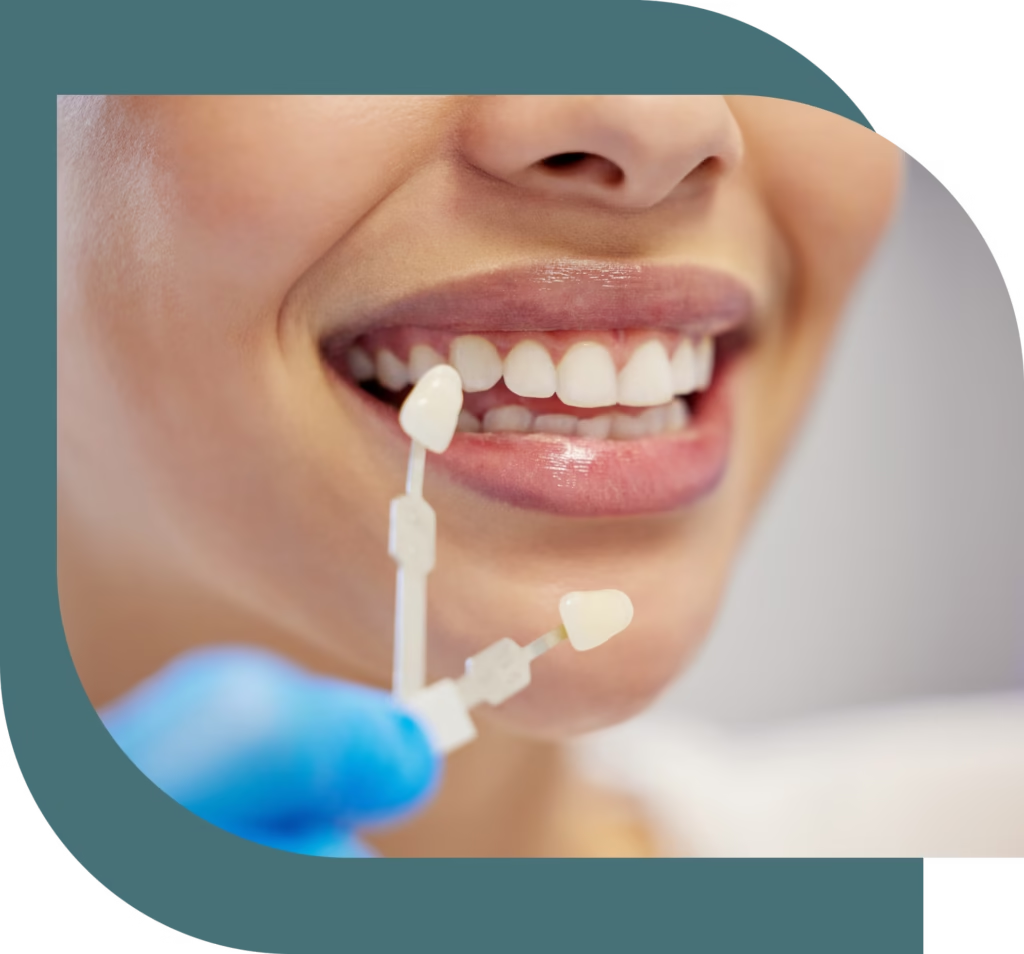
We use a clinical shade guide alongside the whitening baseline and your own preferences to identify the target. Then we discuss it — what you like about your current smile, what bothers you, what you’re hoping to see when the work is done. The MetiSmile preview helps make this conversation concrete: you can see how the planned shade looks in the context of your face before anything is committed.
The result we’re aiming for is a smile that looks like yours — just better. Not one that announces itself as cosmetic work.
Maintaining Your Results
Once whitening and veneers are done, the maintenance routine is reassuringly simple.
Brush and floss normally. Come in for professional cleanings every six months — this is important both for the health of the natural teeth and for checking the condition of the veneers. If you grind your teeth at night, a custom nightguard is worth discussing, because bruxism is one of the most reliable ways to damage veneers over time.
One practical note: porcelain is resistant to staining in a way that natural enamel isn’t. Coffee, red wine, and dark berries will re-stain natural teeth over time but have minimal effect on well-glazed porcelain. This is an advantage of veneers that patients sometimes don’t know about until they experience it.
With proper care, quality porcelain veneers typically last 10 to 15 years. We check them at every routine visit, so if anything is changing, we catch it well before it becomes a problem.
Booking a Cosmetic Consultation
Jenkins Cosmetic and Family Dentistry is at 750 Highlander Point Dr, Floyds Knobs, IN 47119. We serve patients throughout Greenville, New Albany, and the surrounding area. Office hours are Monday–Wednesday 8:30 AM–4:30 PM, Thursday 8:30 AM–3:30 PM, and Friday 8:00 AM–2:00 PM.
Call us at (812) 923-2200 or visit jenkinsfamilydentistry.com to book a cosmetic consultation. Whether you’re thinking about whitening, veneers, or just want to talk through your options before committing to anything, we’re happy to sit down and have that conversation.
Frequently Asked Questions
At our practice, we always recommend whitening your natural teeth before your veneers are placed. Because porcelain doesn’t respond to whitening agents the same way natural enamel does, we need to establish your ideal shade first — then we custom-match your veneers to that brighter tone. The result is a seamlessly uniform smile where everything looks naturally radiant.
Unfortunately, no — whitening treatments only work on natural tooth enamel. If you already have veneers and your surrounding teeth have yellowed over time, the best solution is to whiten the natural teeth and, if needed, consider updating your veneers so everything blends to the same shade. We can assess this at a cosmetic consultation.
We offer professional-grade whitening systems that go well beyond anything available over the counter. Depending on your goals and your teeth’s current condition, we’ll recommend either an in-office treatment for fast, dramatic results, or a custom take-home system for gradual brightening at your own pace. We assess your gum health and enamel before we start to make sure whitening is the right step for you.
We start by thoroughly reviewing your dental health, bite alignment, and what you’d like to change about your smile. From there, we discuss shade options, walk you through what’s realistic for your individual teeth, and map out a personalized treatment plan — which might include professional cleaning, whitening, and veneers, in the right order and on a timeline that suits you.
This is a step we never skip. A thorough professional cleaning removes built-up plaque, tartar, and surface stains that can interfere with both the whitening process and the bonding of veneers. Starting with a clean, healthy foundation protects your gum tissue and gives any cosmetic work the best possible chance of long-term success.
With proper care, porcelain veneers can last anywhere from 10 to 15 years, and often longer. We use high-quality medical ceramic that handles normal chewing forces well. As with anything, daily hygiene matters — consistent brushing, flossing, and regular check-ups with us are the best way to protect your investment.
Yes — and this is one of the key advantages of professional whitening over store-bought kits. We use customised trays and, where needed, desensitising gels that protect your gums and minimise any post-treatment sensitivity. We’ll also evaluate your teeth beforehand so we can adjust the treatment strength to suit you.
You can whiten your natural teeth even if you have existing restorations — the whitening won’t affect the veneers or crowns themselves. If you find your natural teeth are noticeably yellower than your existing restorations, we can assess whether updating those restorations to a brighter shade makes sense as part of your overall plan.
The best maintenance routine is one you can actually stick to: brush and floss daily, limit heavy staining drinks like coffee and red wine (or rinse after), and come in for your six-monthly professional cleaning. We’ll also check on your veneers at each visit to catch any early wear or changes.
We’d love to meet you. Book online through our website or give our front desk a call — we’ll set aside the time to really listen to your smile goals and put together a plan that works for your situation and your budget.